
The Politics of Being A Lady
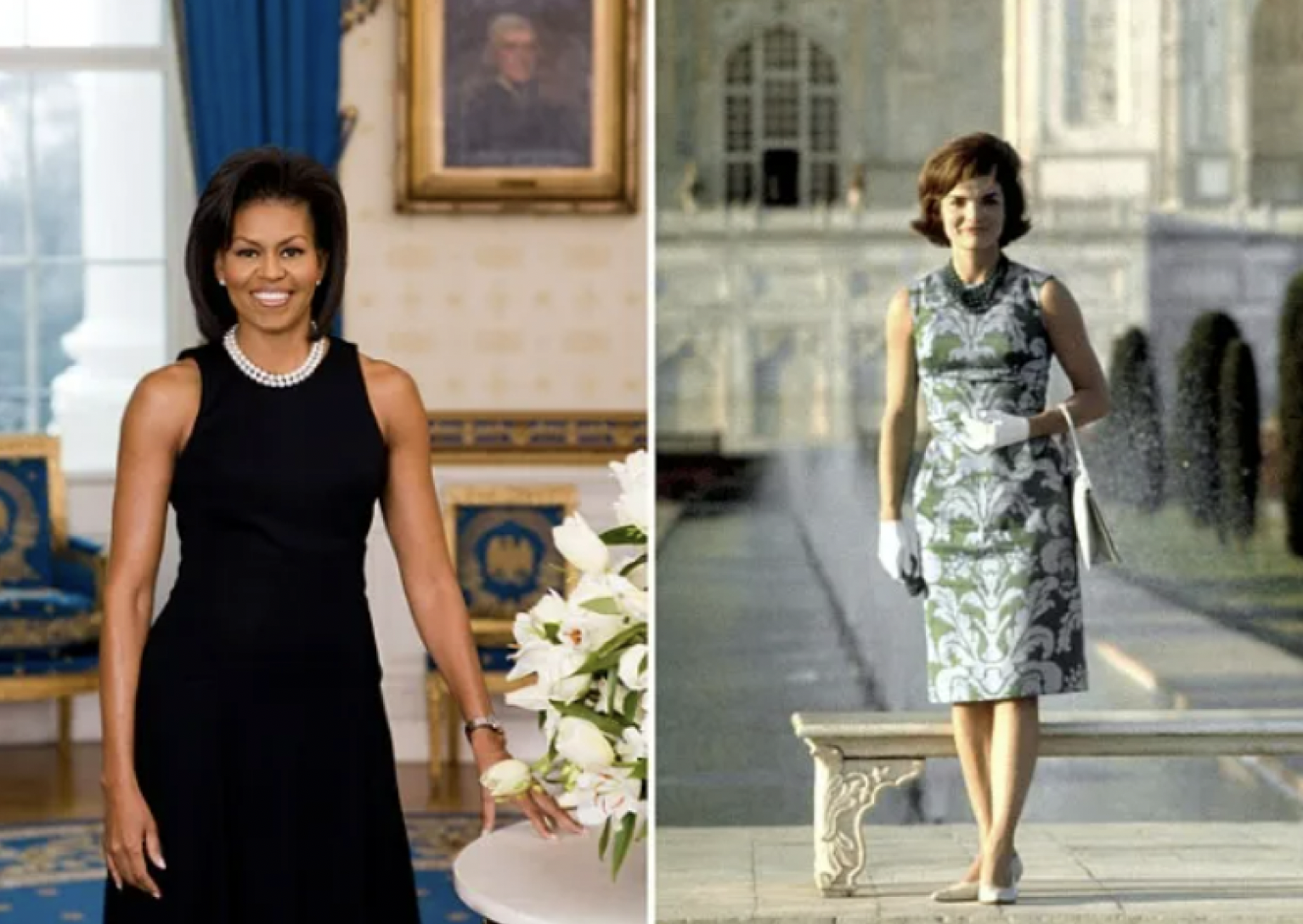
Grace, beauty, flair; The official portrait of First Lady Michelle Obama, taken in the Blue Room of the White House on February 27, 2009. Forty-seven years earlier, First Lady Jacqueline Kennedy struck a similar pose during a visit to India’s Taj Mahal, March 1962. By Joyce N. Boghosian/The White House/A.P. Images (Obama); by Art Rickerby/Time & Life Pictures/Getty Images (Kennedy)
Author’s Note: This short (?) essay is part of a larger analysis in my book, Blackness Personified, which examines images of U.S. Blackness in contemporary German culture.
As a gal from Chicago, it’s hard for me not to be in awe of Michelle Obama. Accomplished and smart, she grew up not far from the neighborhoods where my mom and dad grew up, and was a member of the church my parents once attended. Yet, to see Obama’s coverage in the global media is to be reminded that for her and millions of other Americans of Color, the United States must be survived in order to thrive. Before and after she became First Lady, Obama’s comments about enduring U.S. racial inequality sparked a national commentary in the U.S. media on whether she was uppity, ungrateful, or abrasive. For me, studying Michelle and Barack Obama’s international media reception is a necessary component in a project that examines perceptions of US politics, people, and culture outside of U.S. borders. German news coverage of Obama mirrors themes in U.S. coverage that render her Blackness strange, illustrating the far-reaching, global circulation of specifically located U.S. conversations on race.
Obama’s framing in the global press illustrates the challenges women of color in traditionally white spaces face when we are treated as an interregnum rather than a continuation. Often, the implied visual argument was that in order for Michelle to represent respectability and patriotism, she must first reflect whiteness. For example, in the many comparisons of Obama and former First Lady Jackie Kennedy, there is a distinct implication that Obama’s jewelry, attention to family, and classically cut dresses are part of a decidedly white sensibility, not a deracialized, upper-middle-class one.
In the August 28, 2008, issue of Stern magazine, Michelle O: The Tamed Lion appeared over fifteen pages. The title frames the story as one of a woman who was once wild and young but has since settled into a life of respectability, performing for the masses in the political circus as a lion performs under the big top. The story features images of Michelle on the campaign trail with her husband, as a student, or a young woman in love with the future president of the United States. In narrowing her presentation to moments in life when she would have, decades prior, typically been under the care of guardians or a husband, the magazine makes it easier to connect her to a bygone era in which traditional ideas about a woman’s place in the home and public were more pronounced, making a deeper connection between Obama and Kennedy more plausible. In each comparison image, Obama’s picture is above Kennedy’s. As they peruse the essay, readers overlay the memory of Obama on top of Kennedy, making it impossible to think of one without the [O]ther.
I want to be clear: the problem is not being compared to white people but rather, that whiteness remains the standard by which People of Color, and specifically Black people, are judged. Whiteness is treated as if it is a neutral designation, devoid of political, social, and economic meaning. From a thousand-foot view, the Kennedys and Obamas have more in common than their job titles, making the comparisons between them natural, if not expected. However, the Stern photo essay constructs Obama along a particular plane of visibility, one driven and informed by whiteness. Audiences are visually guided to see all those features—the hair, smile, clothing, children, and dashing husband—and think that the women are more similar than they actually are. Obama is understood as a skilled mimic of Kennedy’s timeless beauty, unable to create her own sense of timeless beauty.
By locating the feminine ideal in a bygone era, Stern solidifies a perception that whiteness has always been the trendsetting ideal, resulting in Obama’s overall erasure. Yet Obama was a media-savvy woman complicit in using fashion as a political strategy to win over her detractors and solidify her popularity as First Lady. Her slim-but-larger-than-a-sample-size body, toned arms that columnist David Brooks snidely referred to as “Thunder and Lightning,” and accessible high/low mix of fashion, created the buzz around her, not a slavish reconfiguration of 1960s fashion trends. What could have been a simple photo essay about two popular public figures instead becomes an essay on how Kennedy saves Obama from herself, teaching her how to be not just a First Lady, but a lady full stop. The difference between comparison and erasure can be seen in other photo essays about the women’s fashion choices. Huffpost.com created a photo essay organized by category: “In Hawai’i”, “On Inauguration Day”, “In Prints”. Each woman’s singular sense of style was on display where they could be appreciated together, but individually. Even when the type of dress and positioning were similar in Vanity Fair’s photo essay, the images looked complimentary, not copy paste.
While all first ladies are compared to those who came before them, the first Black First Lady’s coverage is instrumentalized as a means to solidify the paragons of virtuous white womanhood. In both the German and U.S. media, whiteness is forcefully inserted into representations of a woman who did not feel compelled to reify whiteness at the expense of herself, indicating a global white insecurity as it relates to Black people’s self-actualization. Obama’s coverage, both positive and negative, illustrates how a society overwhelmed and over-infatuated with whiteness relies on erasure to drive a narrative of racially exclusionary success. In other words, racial bias doesn’t always appear in sharp words and angry faces. Sometimes, it arrives in backhanded compliments and bright smiles.
